Which Brain Are You Using?
And why it matters more than you think!
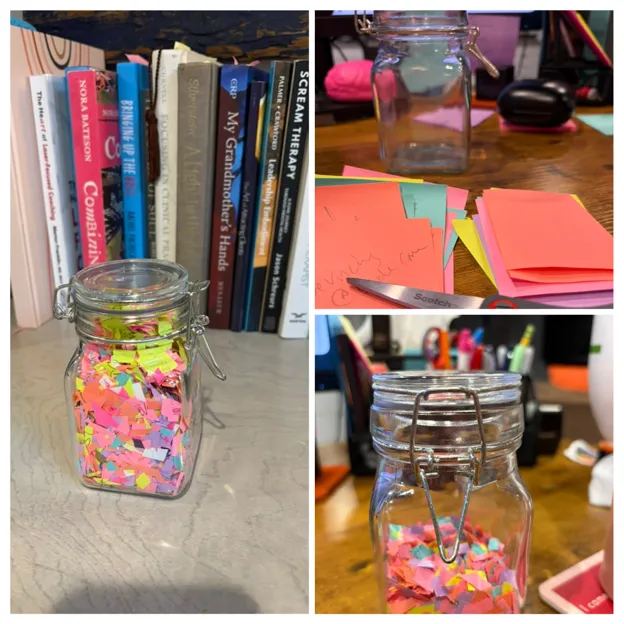
There's a jar on my desk right now. It's full of confetti. Not the party kind, the kind made from old sticky notes, cut into tiny pieces after I finish whatever was written on them. By the end of the month it's nearly full, and I get to dump it in the trash and watch a month of small, finished things flutter down at once. It's a perfect solopreneur party!
I built that jar for a reason. Your brain needs proof that the small stuff counted too. Stay with me, that's going to matter in a minute.
Here's the question: Why does the brain that was crushing it three hours ago suddenly feel like it's bogged down in the muddiest hiking trail after a day of torrential rain?
First, let's take a quick bio break. No, not that kind, the biology lesson kind (and no, not that kind either). Here's what you have experienced about your muscles and already likely know about. You push them hard, fibers tear a little, lactic acid builds up. The ache the next day isn't injury, it's repair in progress. You don't fix it by pushing harder. You fix it with rest, or gentle movement - walking, swimming, casual bike ride - something that moves blood through without adding more strain. Time clears it. Movement speeds it up a little, but time is still required.
Your brain runs the exact same program, just with a different chemical. It's called glutamate, and it builds up every time you're doing something mentally taxing. The only thing that clears it is time spent not doing mentally taxing things. That's it. That's the whole rule.
Here's where it gets sneaky, though. While you're in the zone - hyperfocused, locked in - you're still getting little dopamine hits from staying in the groove, so you don't feel the glutamate stacking up. You just feel comfortable. Right up until you don't. Foggy. Sluggish. Irritable. Maybe even something close to flat, low, blue. And the story you tell yourself in that moment is "I should push through, I'm almost done." And later, when your brain is recovering and you continue to feel sluggish, you say "I'm lazy" or "I'm procrastinating," when the truth is, your brain just ran a mental marathon at a sprint pace. Of course you need to recover. That was never going to be optional.
The five-hour task that takes ten minutes the next day
A colleague of mine runs his own handyman business. He told me he could count on two or three hours of genuinely sharp, focused work a day. After that, the rest of the day quietly dissolved into distraction, and then overthinking the distraction. He'd been calling it procrastination for months. It wasn't. His brain had already cashed in its good hours. Everything after that was a law of diminishing returns wearing a guilt trip as a disguise.
He'd sit down to push through and finish "just one more thing" and somehow lose a few hours, not finish that thing, and then walk away feeling like a failure. Then come back the next morning and finish the exact same thing in ten minutes. That's not him being inconsistent. That's glutamate making it physically harder for his brain to see what was right in front of him the whole time, and forcing him toward small brain tasks instead.
What actually works
Don't wait until you're fried to plan a break. Put a stop point on your calendar before you need one - a timer, a client meeting, an accountability buddy check-in - anything external that pulls you out before your brain has to fight its way out.
Build your small brain task list now, while you have the capacity to think clearly. For me that's clearing out my email inbox, light editing of blogs and content (which I happen to be doing right now), updating my CRM, or making my sticky note confetti. For you it might be vacuuming (like the colleague in the aforementioned story), taking a walk around the block, organizing your files or art supplies, or something else entirely. Doesn't matter what it is, so long as it's genuinely a mental light lift for you. What matters is that when you're depleted, you don't have to think hard about what requires less thinking. You just point at the list and go.
Learn to tell the difference between types of body and brain fatigue. One type tells you that you need a nap, the other tells you that energy will come from movement. Your body knows which one it needs if you actually ask it.
And track the small wins somewhere you can see them. The jar works for me. Find your version. Your brain needs the receipts. It cannot track its own project completion process.
What is true right now
You did something big, and now you're tired.
You are not lazy. You are not behind. You ran a mental marathon at a sprint pace, and nobody told you that the crash afterward was science, not a personal failing.
What is true right now is that recovery isn't the thing that happens after the real work. Recovery is part of the work.
Journal Prompts
What is it costing you to keep mistaking a depleted brain for personal failures?
Where in your week do you push past the point your brain can actually use, and what happens when you crash afterward?
What's actually on your small brain task list, the things you could do on little-to-no fuel at all?
What is true right now about the fatigue you're feeling: is it asking for rest, or asking for movement?
What would shift if you treated recovery as part of the work, not the reward for finishing it?
