You Can't See Your Own Blind Spot
You Can't See Your Own Blind Spot
Picture it. Random Tuesday morning this summer. A coffee shop. A networking conversation. Somewhere in the middle of it, this came up, and I haven't stopped thinking about it since.
All the best. The pros, the ones at the top of their game. They don't do it alone. Not one of them.
The best athletes have coaches. The best executives have coaches. The best people in sales have coaches. Not the struggling ones. The best ones. The ones already winning.
That should tell you something. Coaching isn't the thing you reach for when you're falling apart. It's the thing the people at the top never stop reaching for.
Why the best still need support
Here's the part that trips people up: if you're good, shouldn't you be able to see what's not working? Shouldn't you be able to fix it yourself?
No. And here's why.
We all have blind spots. That's not a flaw, it's just how being a person works. A blind spot isn't something you're hiding from yourself on purpose. It's something you literally cannot see, because you're the one standing inside it.
Then you add in the shadow side, super ego, the inner critic - whatever you want to call it. Most of us have a voice that's been running commentary in the background for years, sometimes decades, telling us what's realistic, what's too risky, what we should already know, what we don't deserve yet. That voice has been talking so long, we've stopped hearing it. We just think it's the truth. We think it's us.
You can't see your own blind spot. You can't attune to a voice that's been talking so long you've stopped hearing it. That's not a character flaw. That's just the limit of doing this alone.
What a coach is actually for
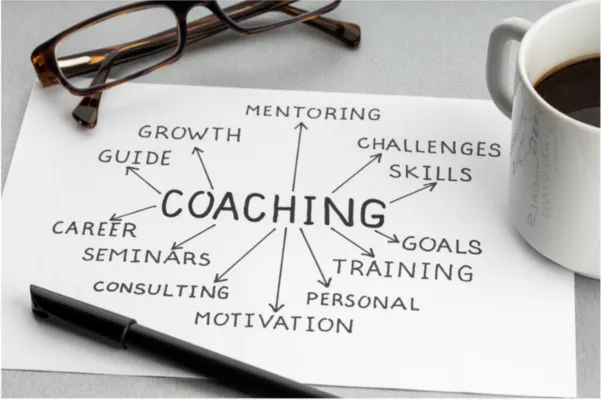
This is why coaching is a game changer, and it has nothing to do with cheerleading.
A coach sees what you can't see. Hears what you've stopped hearing. Names it, out loud, so it's no longer running the show from the background.
And then the real work starts. A coach builds the accountability that keeps you moving after the motivation fades. The exercises that turn insight into a habit instead of a nice conversation you had once. The strategies that get you from where you are to where you're actually trying to go.
Encouragement matters. I'm not knocking it. But encouragement without a plan is just noise that feels good for a minute. A coach helps you train for your next level, the same way an athlete trains for the next season. That is the real work. That's the difference between wanting to grow and actually growing.
The higher you climb, the more particular you get
One more thing worth saying. As you grow, get pickier about who you let into that role. Not everyone who offers advice is equipped to see your blind spot. You want someone who will tell you the truth, not just the parts that feel good, and who has the training and the track record to back it up.
So here's the question I'll leave you with: who's your coach, and how are they helping you get to the next level? If the honest answer is "I don't have one," that's worth sitting with. Not because something is wrong with you. Because you've hit the edge of what you can see on your own.
If you're ready to find out what's in your blind spot, book a discovery call. If you'd rather start in a room with other women doing the same work, come join us at the I RISE kick off workshop on September 14, 2026 2pm. It’s free and allows you to get a taste of my group coaching experience, held twice a year. Learn more and see if the next session is the right fit.
